
PCB Assembly Quote Checklist: Master Your RFQ
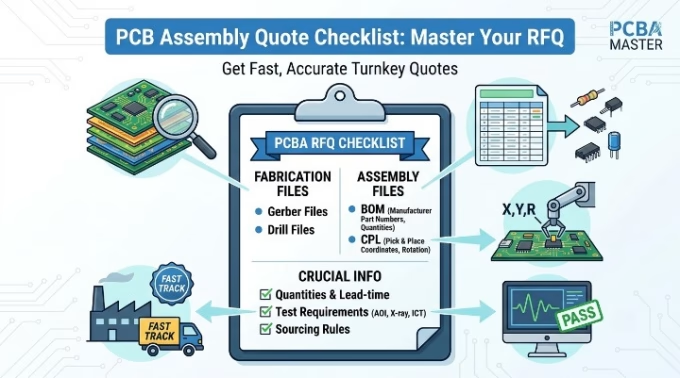
Table Of Contents
1. Introduction
Navigating the Printed Circuit Board Assembly (PCBA) quotation process can often feel like a puzzle with missing pieces. You submit your design, eagerly awaiting a clear price and timeline, only to be met with a barrage of clarification questions, delays, or even inaccurate estimates. The culprit? An incomplete Request for Quotation (RFQ) package.
While a bare board fabrication quote primarily needs board design specifications, a comprehensive PCBA quote demands much more. It requires detailed information about component sourcing, placement, inspection, and testing. Missing any of these crucial details can significantly slow down the quote cycle, introduce inaccuracies, and ultimately delay your project timeline. This guide provides an essential PCB assembly quote checklist, helping you understand precisely what files and information are needed to secure a fast, accurate, and reliable quotation for your next project, from Gerber files to critical Bill of Materials (BOM) and Centroid (CPL) files, alongside detailed test requirements
.
2. Fabrication vs. Assembly: Knowing the Difference
One of the most common misunderstandings leading to incomplete RFQs is conflating a PCB fabrication quote with a PCB assembly quote. These are two distinct scopes:
- PCB Fabrication Quote:This covers the creation of the bare printed circuit board itself. The factory needs data and specifications for the physical board, such as layer count, copper weight, dielectric material, solder mask color, surface finish type, panel size, and quantity. The IPC-2614 standard defines the documentation required for fabrication.
- PCB Assembly Quote:This encompasses the process of populating the bare board with electronic components. It involves component sourcing, placement ( soldering), and often testing. As such, it requires far more detailed information about the individual components and the desired final product functionality.
An assembly quote relies heavily on the quality and completeness of your supplied files, as they dictate not just manufacturing steps but also procurement and quality assurance.
3. The Essential Files for Your PCBA Quote
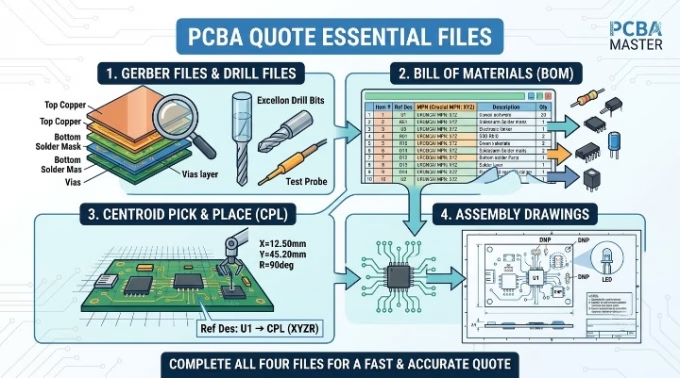
To provide an accurate PCBA quote, manufacturers require a standardized set of files that go beyond the basic board design. These files communicate everything from the physical layout to component specifications and placement instructions. “If even one file is missing or incorrect, it causes production delays, wrong components, assembly defects or extra charges,” according to Electronics & You.
3.1. Gerber Files & Drill Files
Gerber files are the industry-standard format for PCB fabrication data. They describe each layer of the PCB – copper traces, solder mask, silkscreen, paste mask – in a vectorized format. Without complete Gerber files, the bare board cannot even be manufactured.
- Purpose:Defines the physical structure of the bare board.
- What to include:All copper layers (top, bottom, internal), solder mask layers (top, bottom), silkscreen layers (top, bottom), paste mask layers (top, bottom), and outline/mechanical layer.
- Drill Files:These separate files (often in Excellon format) specify the location and size of all drilled holes on the PCB, including vias and component holes. They are critical for both fabrication and ensuring component fit during assembly.
3.2. Bill of Materials (BOM)
The Bill of Materials (BOM) is arguably the most critical document for a PCBA quote, as it acts as the master control document for component sourcing and assembly. A well-prepared BOM directly impacts quote accuracy and assembly quality. “Many PCBA RFQ delays begin with small BOM problems,” notes LEADPCB.
Your BOM should be a clear, unambiguous spreadsheet containing detailed information for every component on the board. Here are the essential fields:
| Field Name | Description | Importance |
| Item Number | Sequential numbering for each unique part. | Organization and easy reference. |
| Quantity | Number of instances of each part on the board. | Crucial for procurement and cost calculation. |
| Reference Designator | Unique identifiers (e.g., R1, C10, U2) corresponding to the schematic and PCB layout. | Links BOM to layout, specifies DNP status. |
| Manufacturer Part Number (MPN) | The exact part number from the component manufacturer. | Absolutely critical for sourcing the correct part. |
| Manufacturer Name | The name of the component manufacturer . | Aids in part identification and sourcing. |
| Description | Brief description (e.g., “Resistor 10k 0402 1%”, “Capacitor 1 uF 0603 50V”). | Confirms correct part type and specifications. |
| Package/Footprint | Component package type (e.g., 0402 , SOIC-8, QFN-32). | Ensures compatibility with PCB footprint. |
| Do Not Populate (DNP) Status | Clearly indicate if a component should NOT be assembled. | Prevents unnecessary purchasing and assembly errors. |
| Approved Alternates | List of approved substitute MPNs and manufacturers. | Provides flexibility in sourcing, especially with supply chain issues. |
Common BOM Pitfalls: Generic descriptions (e.g., “10k resistor”), missing MPNs, unclear DNP status, or a BOM that doesn’t match the CPL file are frequent causes of delays.
3.3. Centroid Pick & Place (CPL) File
Also known as a Pick-and-Place file, XYRS data, or Centroid data, the CPL file is essential for automated assembly. It provides instructions to the pick-and-place machines on where and how to place each component.
- Purpose:Guides automated component placement.
- What to include:
- Reference Designator:Matches the BOM.
- X/Y Coordinates:The precise center (centroid) of each component on the PCB.
- Rotation:The rotational orientation (angle) of each component. This is especially crucial for polarized components like LEDs, diodes, and integrated circuits. Incorrect rotation leads to non-functional or damaged boards.
- Side:Indicates whether the component is placed on the top or bottom side of the board.
Ensure the CPL file accurately reflects your BOM and layout, especially concerning rotation and polarity. For LED assemblies, explicit LED polarity notes are vital (LuminaPCB).
3.4. Assembly Drawings
While not always strictly required for simple boards, assembly drawings provide a visual guide for the assembly process. They can show component outlines, reference designators, special assembly instructions, keep-out zones, and general notes. For complex boards or those with specific manual assembly steps, these drawings are invaluable for avoiding errors and ensuring consistent quality.
4. Beyond the Core Files: Crucial Information for Accuracy
While the Gerber, BOM, and CPL files form the backbone of your RFQ, additional information is critical for obtaining a truly accurate and competitive PCBA quote.
4.1. Quantity & Lead-time Target
The desired quantity and target lead-time significantly influence pricing. Manufacturers often have volume discounts, and expedited lead times typically incur higher costs. Clearly state your required quantities (e.g., 100, 500, 1000 units) and your desired completion date. This allows the manufacturer to optimize their production schedule and component procurement.
4.2. Component Sourcing Rules
Provide clear guidelines on how components should be sourced:
- Approved Vendors:Specify any preferred suppliers or authorized distributors for critical components.
- Substitutions:Clearly indicate whether alternate parts are acceptable, and if so, provide a list of approved alternates with their MPNs and manufacturers within your BOM. This is particularly important in today’s volatile supply chain environment.
- Consigned Parts:If you plan to supply some components yourself, clearly list them as “consigned” in the BOM and provide details on how they will be delivered to the assembler.
4.3. Inspection & Test Requirements
How will the finished boards be inspected and verified? Specifying your test requirements upfront helps the assembler factor these processes into the quote. Common testing methods include:
- Automated Optical Inspection (AOI):Used to check for component presence, polarity, correct part, and solder joint quality.
- X-ray Inspection:Essential for verifying solder joint quality under components like BGAs and QFNs that cannot be visually inspected.
- In-Circuit Test (ICT): Checks for shorts, opens, resistance, capacitance, and other basic electrical parameters of the assembled board. Requires a test fixture.
- Functional Test (FCT):Verifies the board operates according to its design specifications. This often requires a custom test fixture and software. Provide test procedures, firmware, and expected pass/fail criteria.
- Visual Inspection:General quality check by human operators.
4.4. PCB Stack up (If Applicable)
For multi-layer boards or designs with specific impedance requirements, the PCB stack up information is crucial. This document details the sequence and thickness of dielectric materials and copper layers. While primarily a fabrication detail, it impacts the overall board performance and can be important for the assembler to understand the context of your design.
5. Why a Complete RFQ Package Is Your Fastest Path to Production
Submitting a comprehensive PCB manufacturing and assembly package from the outset offers numerous benefits:
- Faster Quote Turnaround:With all information readily available, manufacturers can generate an accurate quote much quicker, eliminating back -and-forth clarifications.
- Accurate Pricing:A complete RFQ prevents unexpected cost increases later in the process due to misinterpretations or missing details.
- Reduced Errors & Delays:Clear instructions minimize the risk of component sourcing mistakes, assembly errors, and production bottlenecks.
- Better Supplier Relationship:A well-prepared RFQ demonstrates professionalism and helps build trust with your manufacturing partner.
- Optimized Manufacturing:With all data in hand, manufacturers can optimize their processes for efficiency and quality, benefiting your project.
Ultimately, a detailed PCBA quote checklist ensures that your manufacturer has everything they need to fabricate, source, place, and test your boards exactly as intended, paving the way for a smooth and successful turnkey PCB assembly.
6. FAQ
- Question 1:What is the difference between a PCB fabrication quote and a PCB assembly quote?
Answer: A fabrication quote covers making the bare circuit board (layers, copper, mask), while an assembly quote covers populating that bare board with electronic components (sourcing, placement, soldering, testing). - Question2:Why is the Manufacturer Part Number (MPN) so important in the BOM?
Answer: The MPN is critical because it precisely identifies the exact component to be sourced. Generic descriptions or missing MPNs can lead to the wrong part being purchased, causing assembly errors or functional failures. - Question3:What is the purpose of a Centroid (CPL) file?
Answer: The CPL file provides XY coordinates and rotation angles for each component, guiding automated pick-and-place machines to precisely position parts on the PCB during assembly. It ensures correct component orientation, especially for polarized parts. - Question4:Do I always need to provide test requirements for a PCBA quote?
Answer: While not always mandatory for a basic quote, providing test requirements (like AOI, X-ray, ICT, or FCT) is highly recommended. It allows the assembler to include inspection and verification costs, ensuring your quote covers quality assurance and helping to prevent defects in the final product.
7. Summary
Securing an accurate and timely PCB assembly quote hinges on providing a comprehensive RFQ package. This checklist emphasizes the critical files and information needed, starting with distinguishing between fabrication and assembly scopes. Essential documents include detailed Gerber files and drill files for bare board specifications, a meticulously prepared Bill of Materials (BOM) with accurate manufacturer part numbers and DNP status, and a precise Centroid Pick & Place (CPL) file for automated assembly. Beyond these core files, vital details such as desired quantity, target lead-time, specific component sourcing rules (including approved alternates), and clear inspection and test requirements are indispensable. By adhering to this PCB assembly quote checklist, you streamline the quoting process, minimize delays, ensure cost accuracy, and ultimately pave the way for a successful PCB manufacturing.
8. Key Takeaways
- A complete RFQ package is crucial for fast, accurate PC BA quotes and avoiding project delays.
- Clearly differentiate between PCB fabrication and assembly quotes; they require different sets of information .
- Essential files include Gerber files, drill files, a comprehensive Bill of Materials (BOM), and a precise Centroid (CPL) file.
- The BOM should include Manufacturer Part Numbers (MPNs), reference designators, quantity, and clear DNP status.
- The CPL file must contain accurate XY coordinates, rotation, and side information for automated assembly machines.
- Provide additional critical details like desired quantity, target lead-time, component sourcing rules, and test requirements(AOI, X-ray, ICT, FCT).
- A thorough RFQ package prevents clarification cycles, reduces errors, and leads to a more efficient turnkey PCB assembly.
OrinewPCB has been providing reliable one-stop PCB solutions for over 14 years, covering everything from PCB manufacturing and electronic component sourcing to assembly, testing, and IC programming. With a strong commitment to quality and fast delivery, we help global clients bring their products to market efficiently.
Contact Us
Phone: +86-18123905375
Email: sales@assemblepcb.com
WhatsApp: +86-18123905375
Wechat: +86-18123905375
Free Queto
Latest Blog

Table Of Contents
Contact Us
Phone: +86-18123905375
Email: sales@assemblepcb.com
WhatsApp: +86-18123905375
Wechat: +86-18123905375
Free Queto
