
What is a High-Density Interconnect (HDI) PCB?
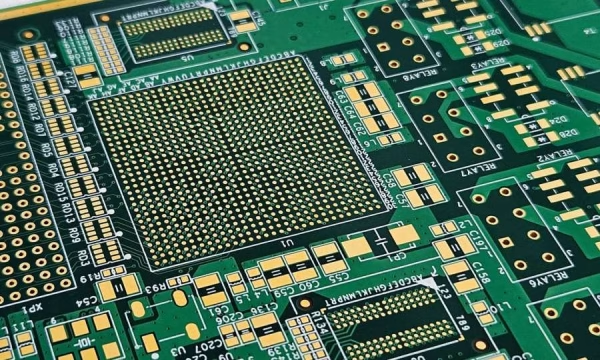
Table Of Contents
In the relentless pursuit of smaller, faster, and more powerful electronic devices, engineers constantly push the boundaries of design and manufacturing. At the forefront of this innovation lies the High-Density Interconnect (HDI) Printed Circuit Board. HDI PCBs are a cornerstone of modern electronics, enabling incredible miniaturization without compromising performance. This comprehensive guide will delve into what defines an HDI PCB, its various types, key features, advantages, design considerations, manufacturing processes, and its pervasive applications across industries.
1. What Exactly is a High-Density Interconnect (HDI) PCB?
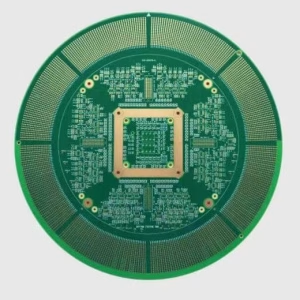
A High-Density Interconnect (HDI) PCB is a type of printed circuit board characterized by a higher wiring density per unit area than conventional PCBs. This is achieved through advanced manufacturing techniques that allow for finer lines and spaces, smaller capture pads, and the use of microvias, blind vias, and buried vias. Essentially, an HDI PCB packs more functionality into a smaller physical space, making it indispensable for today’s compact and sophisticated electronic devices.
The defining characteristic of HDI technology is the use of microvias—typically less than 150 microns in diameter. These tiny vias play a crucial role in increasing routing density. Unlike traditional through-hole vias that pass through all layers, microvias can be laser-drilled, allowing for more precise and space-efficient interconnections between layers.
2. Key Features Defining HDI PCBs
Several key features distinguish HDI PCBs from standard multi-layer boards:
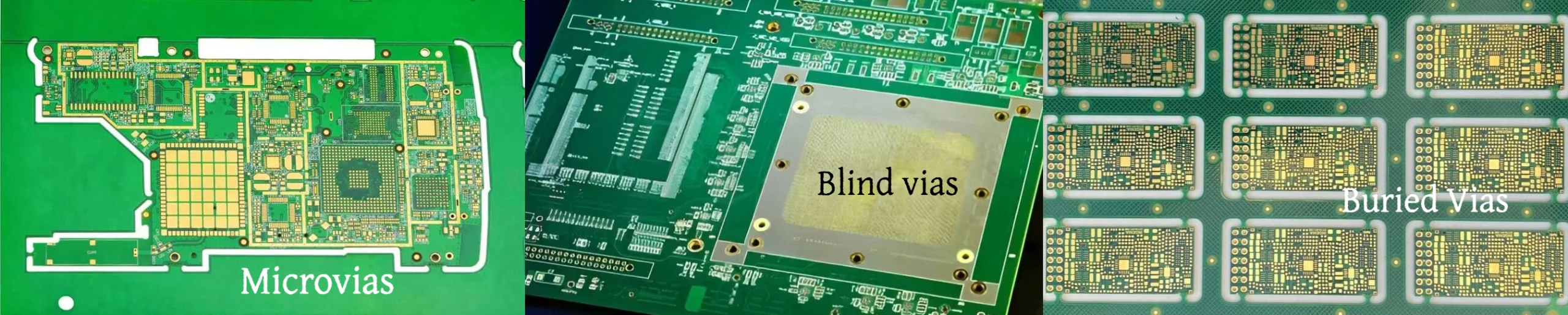
- Microvias:These extremely small diameter vias (less than 6 mil or 0.15mm) are typically laser drilled . They conserve valuable board real estate by connecting only a few layers, unlike traditional mechanical drills that penetrate the entire board.
- Blind and Buried Vias:Blind vias connect an outer layer to one or more inner layers but do not pass through the entire board. Buried vias connect two or more inner layers and are not visible from the outer layers. Both significantly reduce the need for through-hole vias, freeing up space for more components and traces.
- Finer Lines and Spaces:HDI technology allows for trace widths and spacing as small as 2-3 mil (0.05-0.075mm), dramatically increasing the routing density.
- Higher Component Density:With reduced via sizes and finer lines, more components can be placed closer together on both sides of the board, leading to significant miniaturization.
- Improved Electrical Performance:Shorter signal paths, reduced parasitic capacitance and inductance, and better impedance control contribute to enhanced signal integrity and reduced noise, crucial for high-frequency applications.
- Reduced Board Size and Weight:The ability to pack more functionality into a smaller area directly translates to lighter and more compact final products.
3. Advantages and Considerations of HDI PCBs
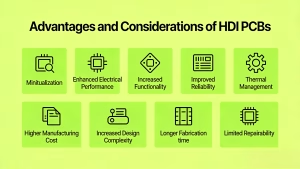
High-Density Interconnect PCBs offer a myriad of advantages that drive their widespread adoption, alongside some inherent complexities and potential disadvantages.
3.1 Advantages of HDI PCBs
- Miniaturization:The primary benefit is the significant reduction in board size and weight, allowing for smaller, lighter, and more portable electronic devices.
- Enhanced Electrical Performance:Shorter trace lengths, improved signal integrity, and reduced electromagnetic interference (EMI) are critical for high-speed and high-frequency applications.
- Increased Function ality:More components and routing paths can be accommodated within the same or even smaller footprint, leading to more powerful and feature-rich products.
- Improved Reliability:Smaller vias and finer lines can reduce the chances of open circuits or short circuits, and the controlled impedance enhances overall system reliability.
- Thermal Management:HDI structures can sometimes offer better thermal pathways due to the shorter distances and optimized stack-ups, although complex designs might require dedicated thermal solutions.
3.2 Considerations (Potential Disadvantages) of HDI PCBs
- Higher Manufacturing Cost:The specialized equipment (e.g., laser drills), advanced materials, and more complex fabrication processes make HDI PCBs more expensive than conventional PCBs.
- Increased Design Complexity:Designing HDI boards requires sophisticated CAD tools and highly skilled engineers due to the intricate layer stack-ups, via structures, and tight tolerances.
- Longer Fabrication Time:The multi-step laser drilling, plating, and sequential lamination processes are more time-consuming compared to standard PCB manufacturing.
- Limited Repairability:Due to the fine pitch components and buried/blind vias, repairing or reworking HDI boards can be challenging and sometimes impossible.
4. Exploring the Different Types and Structures of HDI PCBs

HDI PCBs are categorized into various types based on their stack-up and the complexity of their microvia structures. These types are often denoted by a numerical system (Type I through Type VI), indicating the number of sequential lamination steps and the arrangement of microvias.
4.1 Understanding HDI Structures
- Sequential Lamination:The key to HDI PCB construction is sequential lamination, where layers are added and processed one at a time, allowing for the creation of microvias that only span specific layers.
- Microvia Placement:Microvias can be created on the outer layers (connected to pads), or stacked/staggered within the inner layers.
4.2 Comparison of HDI PCB Types
| HDI Type | Structure Description | Complexity Level | Common Applications |
| Type I (1+N+1 ) | Single microvia layer on each outer side. Simple build, one sequential lamination. Non-stacked microvias. | Basic | Smartphones, laptops, consumer electronics. |
| Type II (i+N+i) | Two or more microvia layers with offset/staggered microvias and/or buried vias. One or more sequential laminations. | Medium | Advanced mobile devices, medical devices, automotive control units. |
| Type III (i+N+i) | Two or more microvia layers with stacked and filled microvias and/or buried vias. Multiple sequential laminations. | High | High-performance computing, complex medical devices. |
| Type IV ( Any Layer) | “Any Layer” HDI. Every layer can be an interconnection layer with laser-drilled microvias, often stacked and copper-filled. | Very High | High-end servers, defense, aerospace, advanced RF applications. |
| Type V | Coreless construction with all layers containing microvias. Fewer limitations on routing and design flexibility. | Extremely High | Ultra-compact wearable devices, advanced sensor modules. |
| Type VI | Similar to Type V but with enhanced features for even greater density and performance , potentially using advanced materials or finer structures. | Cutting-Edge | Future generation high-performance systems. |
The “N” in the structures (e.g., 1+N+1) typically refers to the number of core layers, while “1” or “i” denotes sequential build-up layers with microvias.
5. HDI PCB Design Considerations
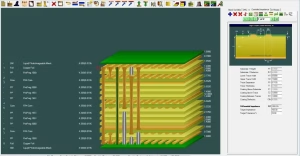
Designing an HDI PCB is a meticulous process that requires careful attention to various factors to maximize performance and manufacturability.
- Stack-up Optimization:A well-planned layer stack-up is crucial. It dictates signal integrity, power distribution, thermal performance, and overall manufacturability. Engineers must decide on the number of layers, material types (dielectric constant, loss tangent), and the arrangement of ground and power planes.
- Microvia and Via-in-Pad Technology:Utilizing microvias and placing vias directly in component pads (via-in-pad) significantly reduces board size and improves routing density. This requires careful consideration of laser drilling capabilities and filling techniques ( e.g., copper fill).
- Trace Width and Spacing:Designing with the finest possible trace widths and spaces (e.g., 2-3 mil) to achieve maximum routing density, while respecting manufacturing capabilities and impedance control requirements.
- Impedance Control:Maintaining consistent impedance for high-speed signals is paramount. This involves precise control over trace geometry, dielectric thickness, and material properties.
- Thermal Management: With higher component density, heat dissipation becomes a critical concern. Designers must incorporate thermal vias, optimized copper pours, and potentially specialized substrate materials to manage heat effectively.
- Material Selection:Choosing appropriate low-loss dielectric materials and copper foil types is essential for high-frequency performance and overall reliability.
- Design for Manufacturability (DFM):Early collaboration with the PCB manufacturer is vital to ensure the design adheres to their specific process capabilities and tolerances, preventing costly redesigns.
6. The Manufacturing Process of HDI PCBs
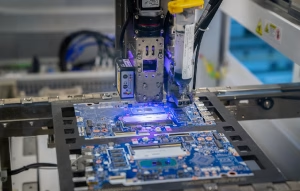
The manufacturing process for HDI PCBs is significantly more complex than conventional PCBs, primarily due to the sequential build-up and micro via creation.
- Core Material Preparation: Starting with a conventional core (double-sided or multi-layer) that may contain buried vias.
- Dielectric Layer Lamination:A thin layer of dielectric material (prepreg) is laminated onto the core.
- Laser Drilling:Microvias are created through the newly added dielectric layer using precise laser drilling technology (CO2 or UV lasers). This allows for very small hole sizes and high accuracy.
- Desmear and Electroless Copper Deposition:The drilled holes are chemically cleaned (desmeared) to remove resin residue, and a thin layer of electrol ess copper is deposited to make the hole walls conductive.
- Electrolytic Copper Plating:The microvias and surface traces are then electroplated with copper to build up the desired copper thickness. For stacked microvias , these vias are often filled with copper.
- Photolithography and Etching:Photoresist is applied, exposed to UV light through a mask, and developed to define the circuit patterns. Unwanted copper is then etched away.
- Repeat Sequential Lamination:Steps 2-6 are repeated for each additional sequential build-up layer until the desired stack-up is achieved. This forms the complex HDI structures.
- Outer Layer Processing:Once all inner layers are complete, the outer layers are processed similarly, including applying solder mask, silk screening, and surface finish (e.g., ENIG, HASL).
- Final Fabrication :The board undergoes routing (cutting into individual PCBs), electrical testing (E-test), and final inspection.
7. Applications of HDI PCBs: Powering Modern Electronics

HDI PCBs are the unsung heroes behind countless advanced electronic devices, enabling the compact, high-performance gadgets we rely on daily. Their ability to deliver high functionality in a small footprint makes them indispensable across diverse industries:
- Consumer Electronics:Smartphones, tablets, laptops, smartwatches, wearable devices, digital cameras, and gaming consoles all extensively utilize HDI technology for miniaturization and performance.
- Medical Devices:Compact and high-precision medical equipment such as pacemakers, hearing aids, diagnostic tools, and portable monitoring devices benefit from HDI’s small size and reliability.
- Automotive Industry:Advanced Driver-Assistance Systems (ADAS), infotainment systems, engine control units (ECUs), and GPS systems often incorporate HDI PCBs for their robustness and performance in demanding environments.
- Aerospace and Defense:Mission-critical avionics, satellite systems, radar equipment, and guidance systems require HDI PCBs for their high reliability, shock resistance, and ability to withstand extreme conditions while minimizing weight.
- Industrial Control Systems:Robotics, automation equipment, and specialized sensors leverage HDI PCBs for their robust performance and ability to integrate complex functionalities in constrained spaces.
- Telecommunications:Network infrastructure, base stations, and high-speed data transmission equipment use HDI to manage high-frequency signals and achieve dense connectivity.
8.FAQs
9.Summary
High-Density Interconnect (HDI) PCBs are a pivotal technology driving the evolution of modern electronics. Defined by their use of microvias, blind and buried vias, and finer trace geometries, they enable an unprecedented level of miniaturization and functionality. While offering significant advantages in space savings, enhanced electrical performance, and increased reliability, their manufacturing complexity and higher costs necessitate careful design and production planning. From basic Type I structures to advanced “Any Layer” designs, HDI PCBs are at the heart of compact, high-performance devices across consumer, medical, automotive , and aerospace sectors, continually pushing the boundaries of what’s possible in electronics.

Contact Us
Phone: +86-18123905375
Email: sales@assemblepcb.com
WhatsApp: +86-18123905375
Wechat: +86-18123905375
Free Queto
Latest Blog
Table Of Contents
Contact Us
Phone: +86-18123905375
Email: sales@assemblepcb.com
WhatsApp: +86-18123905375
Wechat: +86-18123905375
Free Queto